How Real Estate Investing Has Changed My Life

Aaron Bellmore • January 2, 2022
So what has allowed me create financial success for myself? Real Estate!

Today I want to start digging into how real estate has allowed me to create financial success for not only myself but also many other investors.


When I was just twenty four years old a friend of mine sent me a book called ―Rich Dad, Poor Dad (by Robert Kiyosaki) and that sparked my interest in real estate investing. At the time I was trading my time for money as an apprentice pipe-fitter,  I was making pretty good money and trying to put some of it away – but it was tough to save diligently.


This was even more true when the love of my life, Tricia told me that she was pregnant with our first son (we now have three).

With what I learned from the book, as well as some good advice from a friend, I bought two rental properties as well as our own first home. Then one day on the dreary drive to work, I had a life-changing ah-ha‘ moment that I will always remember.


I thought to myself If I could just hold onto these three properties for 25 years, I would be able to retire early at the age of 50 and have a million dollars in equity as well as enough cash flow to bring in at least $60,000 per year to live on.


The properties would be free and clear and cashflowing like crazy. At that point I realized that I‘d stumbled upon a very good thing. I was hooked on this idea of buying properties and holding on to them for the long term. I decided to focus on buying residential properties (single family homes and apartment buildings) and I chose Grande Prairie as the market to buy in.

After some initial trial and error, I quickly developed my own unique niche‘...providing FURNISHED rentals (or as I like to call them, ―Super Suites). By adding furniture to a rental unit, I was able to generate 2-3 times the PROFIT compared to the same property being unfurnished. Thanks to investing in real estate, by age 27 I was able to quit my high-paying pipefitter j.o.b. and

become a full-time real estate entrepreneur and stay-at-home dad.


Since then, together with my investor partners, I‘ve created a multi-million dollar portfolio of over 70 rental units. My partners enjoy an above- average return on their money, along with a major growth in their net-worth. Not only has real estate investing allowed me to create our dream life-style for my family and I, but it‘s also helping my investor partners to enjoy profits today, as well as long-term wealth. I hope you enjoy reading this post as much as I‘ve enjoyed working on it. When you are ready to

start benefiting from my ―No Sweat‖ investing strategy, please give me a call at 780-882-3396.


Aaron Bellmore

Aaron Bellmore

Fresh Coast Investments

Corporate housing apartment interior with sofa, lamp, and city view in Grande Prairie
By Freshcoast Investments September 14, 2026
Learn how corporate housing in Grande Prairie differs from vacation rentals and why professionally managed furnished homes serve mobile workforces in 2026.
Grande Prairie Real Estate 2026 Outlook over a suburban street and houses at sunset
By Freshcoast Investments September 7, 2026
See the four local signals Grande Prairie investors should watch through late 2026, from housing supply and workforce demand to rental operations and financing.
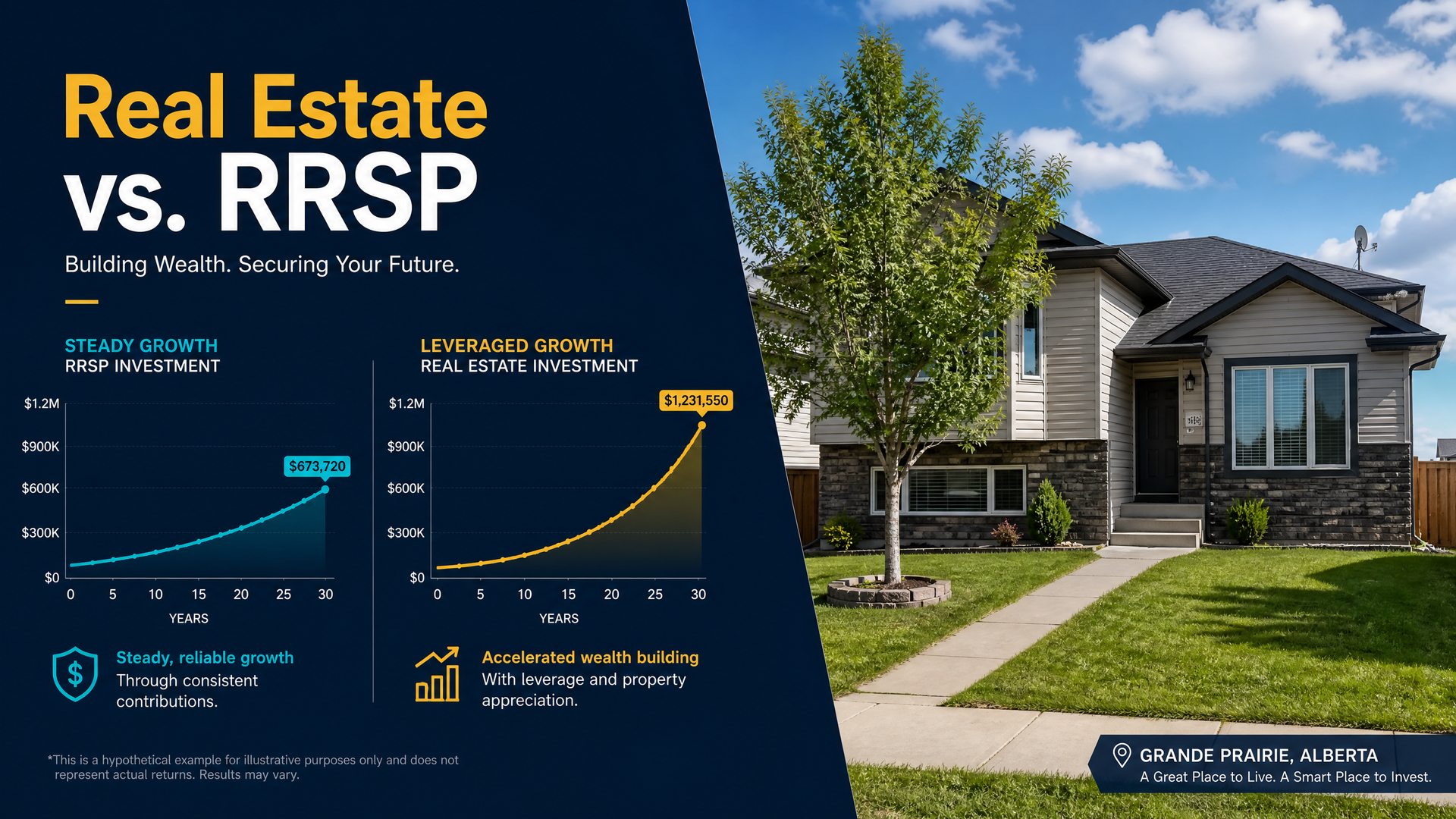
Infographic comparing real estate and RRSP growth beside a suburban house photo
By Freshcoast Investments August 24, 2026
For decades, the Registered Retirement Savings Plan (RRSP) has been the default wealth-building strategy for Canadians. The premise is simple: contribute pre-tax income, invest in mutual funds or stocks, and let the market grow your nest egg until retirement. However, as the economic landscape evolves in 2026, many investors are questioning whether the traditional RRSP is still the most effective way to build significant wealth, or if private real estate offers a superior path. Comparing real estate to an RRSP is not an apples-to-apples exercise. They operate on entirely different financial mechanics. To determine which strategy builds more wealth, we need to look at three critical factors: leverage, cash flow, and asset control. The Power of Leverage The single greatest advantage of real estate investing is leverage. When you invest in an RRSP, your return is based solely on the cash you contribute. If you put $50,000 into a mutual fund and it grows by 5%, you earn $2,500. In real estate, that same $50,000 can serve as a 20% down payment on a $250,000 property. If that property appreciates by a conservative 3% in a year, your asset has grown by $7,500. You are earning a return on the bank's money, not just your own. This magnification of returns is why real estate consistently creates more millionaires than traditional stock market investing. Over a 10- or 20-year horizon, the compounding effect of leveraged appreciation dramatically outpaces the unleveraged growth of a typical RRSP portfolio. Cash Flow and Debt Paydown An RRSP is a purely speculative investment; you are hoping the value of your shares increases over time. It does not pay your bills today. A well-structured real estate investment, however, is a multi-dimensional wealth builder. First, a strong rental property generates positive monthly cash flow—money in your pocket after all expenses and the mortgage are paid. Second, your tenants are paying down the principal on your mortgage every single month. Even if the property value remained completely flat for five years, you would still be significantly wealthier because the debt against the asset has been reduced by someone else's money. This dual-action growth—cash flow plus principal paydown—is entirely absent in an RRSP. Tax Implications and Asset Control The primary appeal of an RRSP is the upfront tax deduction. However, it is important to remember that an RRSP is a tax-deferral vehicle, not a tax-free one. When you eventually withdraw the funds in retirement, every dollar is taxed as regular income, often at a time when you have fewer deductions available. Real estate offers a different suite of tax advantages. While rental income is taxable, you can deduct mortgage interest, property taxes, insurance, maintenance, and depreciation (Capital Cost Allowance) against that income. When you eventually sell the property, the profit is taxed as a capital gain, which is currently taxed at a lower effective rate than the regular income withdrawals from an RRSP. Furthermore, real estate gives you control. You cannot influence the quarterly earnings of a publicly traded company in your RRSP. But with real estate, you can force appreciation through renovations, improve cash flow by optimizing management, or pivot to a furnished rental strategy to increase yield. The Third Option: Hands-Free Private Real Estate The main reason Canadians stick to RRSPs is convenience. Buying a mutual fund takes five minutes; buying and managing a rental property is a massive undertaking. But what if you could combine the high-yield, leveraged growth of real estate with the hands-free convenience of an RRSP? This is the exact gap that Fresh Coast Investments fills. We offer accredited investors and joint venture partners the ability to deploy capital into the robust Grande Prairie real estate market without ever swinging a hammer or screening a tenant. We handle the acquisitions, the management of our 148 furnished units, and the daily operations, while you benefit from the cash flow and equity growth of a real, tangible asset. If you are looking to diversify away from public markets and build wealth through asset-backed real estate, book a call with Aaron to discuss how our co-investment model compares to traditional retirement planning.