Grande Prairie Market Update — July 2026

Freshcoast Investments • July 21, 2026

As we cross the midpoint of 2026, the Grande Prairie real estate market continues to demonstrate the resilience and steady growth that makes it a prime target for strategic investors. While national headlines often focus on the volatility in major centers like Toronto and Vancouver, our local market in northwestern Alberta is quietly delivering strong fundamentals. The story this summer is one of tight supply, steady demand, and firm pricing.


For investors holding assets in the region, the current data reinforces the value of a long-term hold strategy. For those looking to deploy capital, the market conditions highlight the importance of moving decisively when the right opportunity arises. Here is a detailed look at where the Grande Prairie market stands in July 2026.


By the Numbers: Supply and Demand

The defining characteristic of the Grande Prairie market right now is limited inventory. As of our latest data pull, there are only 154 active listings within the city limits. This low supply environment fundamentally shapes the dynamics of every transaction.


Year-to-date, we have seen 643 homes sold in the city. While this represents a 7.6 percent decrease in total sales volume compared to the same period in 2025 (which saw 696 sales), it is crucial to understand that this dip in volume is driven by a lack of available product, not a lack of buyer interest. There simply are not enough homes on the market to satisfy the current demand.


Price Appreciation and Equity Growth

When demand outpaces supply, prices rise. This economic principle is clearly visible in the Grande Prairie data. The average sale price year-to-date in 2026 sits at $401,250. This is a solid 5.1 percent increase over the average price of $381,640 recorded at this same point last year.


For current property owners and joint venture partners, this 5.1 percent year-over-year appreciation represents pure equity growth. It is a testament to the stability of the local economy and the ongoing influx of professionals moving to the region for opportunities in the energy, forestry, and agricultural sectors. This steady, sustainable appreciation is exactly what we look for when acquiring assets for the Fresh Coast portfolio.


The Investor Perspective: Navigating a Tight Market

Operating in a low-inventory, rising-price environment requires discipline. For retail buyers looking for a primary residence, the current market can be frustrating, often resulting in multiple-offer scenarios for well-priced homes. For investors, however, the strategy remains focused on the math.


At Fresh Coast Investments, we do not buy the market; we buy the deal. Even in a tight market with only 154 active listings, opportunities exist if you know where to look and how to underwrite them. Our focus remains on acquiring properties that fit our specific furnished rental model—homes that can be optimized to generate 2-3x the profit of standard rentals. The fact that overall market prices are rising simply adds an additional layer of equity growth on top of our strong operational cash flow.


Looking Ahead to the Fall

As we move through the summer and look toward the fall of 2026, we expect these market conditions to hold steady. Alberta’s nation-leading GDP growth projections and ongoing investments in the energy sector will continue to drive employment and migration to Grande Prairie. Unless we see a sudden and dramatic influx of new listings, the supply-demand imbalance will keep a firm floor under property values.


If you are an accredited investor or are interested in a joint venture partnership, now is the time to get your capital positioned. The market is moving, and having your strategy in place ensures you are ready when the right asset is identified.


Want to learn more about our current acquisition targets? Book a call with Aaron today.

Aaron Bellmore

Fresh Coast Investments

Grande Prairie property tax certificates over snowy cityscape and paperwork with charts
By Freshcoast Investments • November 5, 2026
Learn what a Grande Prairie property tax certificate shows, how it differs from City searches, and the key questions rental investors can ask when closing.
Fixed-term vs. periodic leases in Alberta investor guide over snowy neighborhood street
By Freshcoast Investments • October 26, 2026
For a furnished-rental investor, the lease is not only a document that sets the rent. It is part of the operating plan. The term of the agreement affects move-in planning, utilities, furnishing care, renewal conversations, vacancy risk, and how a property can respond to a tenant’s changing needs. In Alberta, the first distinction to understand is whether an agreement is fixed term, periodic, or a hybrid of the two. This guide provides a practical overview for investors evaluating furnished residential operations in Grande Prairie. It does not replace legal advice or determine which arrangement is appropriate for a particular property. The actual agreement, the nature and length of occupancy, condominium bylaws, and current Alberta law all matter. A qualified Alberta legal professional should review the specific documents and facts. The Three Tenancy Formats Investors Should Know Alberta identifies two main types of rental agreement: fixed term and periodic. It also recognizes that some arrangements begin as fixed term and later transition to periodic, often called hybrid tenancies. Each format creates a different operating rhythm. Fixed-term agreement A fixed-term tenancy has a specific start date and end date. According to Alberta’s guidance, the tenancy ends automatically on the stated end date; neither party needs to give notice to end it at that point. This can give both the landlord and tenant a defined planning horizon, provided the agreement clearly identifies the term and any renewal process. Periodic agreement A periodic tenancy has a start date but no defined end date. It can be month-to-month, week-to-week, or year-to-year, and either party may end it by giving the legally required notice. This flexibility can suit some tenant situations, but it also requires an investor to plan carefully for notice periods and potential changes in occupancy. Hybrid agreement A hybrid tenancy begins as a fixed term and transitions into a periodic tenancy after the fixed term expires. Alberta notes that this can arise through the agreement itself or through the conduct of the landlord and tenant when they intend the tenancy to continue. A hybrid approach may be useful in some circumstances, but the transition should be deliberate, documented, and understood by both parties rather than assumed. Why the Lease Structure Matters in a Furnished Rental Furnished housing often includes a broader set of services and assets than a typical unfurnished home. Utilities, internet, furniture, kitchenware, parking, cleaning expectations, access instructions, and property rules all need to be clear. The lease term establishes the framework around those practical commitments. For example, a fixed term may align with a known assignment, relocation period, or temporary household need. A periodic tenancy may be more suitable when the duration is less certain and both parties value flexibility. Neither choice automatically produces a better investment outcome. The appropriate approach depends on the property, the tenant need, the operating model, and the legal agreement. In Grande Prairie, furnished homes can support a range of local housing needs connected to workforce mobility, regional services, and relocations. The City of Grande Prairie identifies agriculture, forestry, and oil and gas among the economic foundations of the community. A local operating strategy should therefore match the lease structure to the realistic use of the specific property rather than applying one standard term to every unit. A Practical Comparison for Rental Investors Planning certainty A fixed term provides a known end date, which may help an operator plan inspections, cleaning, furnishing refreshes, and the next occupancy period. It does not remove the need for good communication or contingency planning. A tenant may have an unexpected change in circumstances, and the agreement should clearly address any options, subject to applicable law. A periodic tenancy can make it easier for an occupancy arrangement to continue without renegotiating a new end date each time. It also means that the owner must understand the notice rules that apply if the tenancy needs to end. Alberta’s current guidance explains that notice requirements vary by tenancy type and by whether the landlord or tenant is giving notice. Utility and service allocation All-inclusive furnished housing can be convenient for tenants, but it requires precise documentation for owners. Alberta recommends that a written residential tenancy agreement state what is provided and at whose expense, including utilities, furniture, appliances, parking, and insurance requirements. Investors should ask how the agreement describes internet, gas, electricity, water, parking, furnishings, and any cleaning or maintenance obligations. If charges change, if utility use is unusually high, or if an item must be replaced, the operating response should be considered before—not after—the lease is signed. Furnishings and property condition Furniture and housewares are part of the rental product. A well-managed furnished home should have a move-in condition record and a practical way to document the inventory. This supports clear expectations, helps resolve questions at move-out, and informs replacement planning over time. Investors do not need to be involved in every turnover task, but they should understand whether the operator maintains an inventory process, how damage is reported, and how furnishings are refreshed. A lease term is only one part of a system that must preserve both the resident experience and the physical asset. Essential Terms for a Furnished Rental Agreement Alberta states that written agreements are preferable because they provide evidence if there is a dispute, even though a tenancy agreement may be written, verbal, or implied. 1 The province’s guidance lists core items for a written residential tenancy agreement, including the parties, premises, term, rent, utilities, furnishings, parking, permitted occupants, security deposit, maintenance responsibilities, insurance requirements, and rules for guests and pets. Term and renewal language The agreement should clearly state whether it is fixed term, periodic, or intended to become periodic after a fixed period. For a fixed term, it should identify the start and end dates. For a periodic agreement, it should identify the tenancy period. Any renewal discussion should reflect the agreement and current legal requirements. What is included in the home Document the included furniture, appliances, utilities, internet, parking, storage, and any shared or excluded areas. The more specific the agreement and inventory, the less room there is for misunderstanding about the furnished-rental experience. Care, maintenance, and reporting The agreement should set out how the tenant reports repairs, how the operator communicates access for necessary work, and which responsibilities belong to the landlord or tenant. Alberta requires landlords to make a rental premise available at the start of the tenancy, respect peaceful enjoyment, and ensure the premises are habitable at the beginning and throughout the tenancy. Insurance and building rules Where appropriate, the agreement should address insurance expectations and any condominium or building rules. Alberta notes that condominium tenants must follow the corporation’s bylaws and that condominium owners who rent their unit have notice obligations to the corporation. The applicable documents should be reviewed for the particular unit rather than assumed from another property. How Professional Management Supports Lease Discipline Lease design is only valuable when it is supported by a consistent operating process. For Fresh Coast’s furnished residential model, that process includes preparing the property, coordinating tenant stays, managing maintenance, and maintaining the reporting systems investors expect. The goal is not to remove every risk; it is to make the rental experience and the management responsibilities clear. For an investor, useful questions include: How does the operator choose a lease structure? Who reviews the agreement? How are utilities and furnishings tracked? What happens when a term ends? How are building rules and insurance needs verified? And what reporting shows whether the operating plan is being followed? Choose Clarity Over a One-Size-Fits-All Lease Fixed-term and periodic agreements each have a role in Alberta residential real estate. A thoughtful furnished-rental operator selects a structure that fits the property, the tenant need, and the applicable legal framework—and documents it clearly. Investors should view lease structure as part of property-level risk management, not as a minor administrative choice. To learn how Fresh Coast approaches furnished residential operations in Grande Prairie, Book a call . This article is general educational information only and is not an offer to sell securities or personalized investment, legal, or tax advice. Alberta tenancy rules and the applicability of an agreement depend on the specific arrangement, so obtain qualified legal advice before relying on any lease term or tenancy decision.
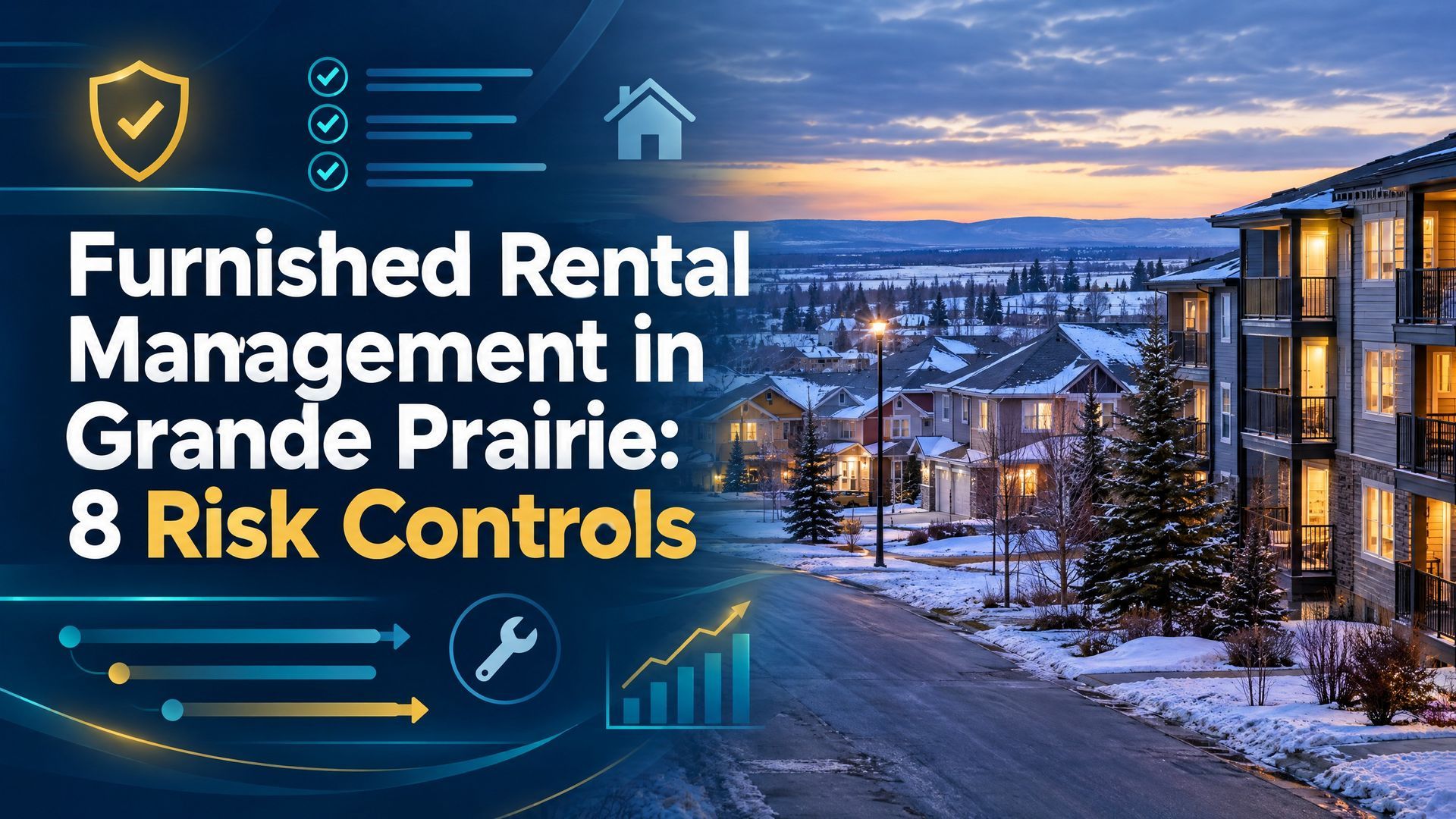
Furnished rental management in Grande Prairie with “8 Risk Controls” text over a snowy cityscape at dusk
By Freshcoast Investments • October 19, 2026
Furnished rentals are often described in terms of convenience: a home is equipped, utilities are arranged, and a tenant or guest can arrive with far less setup than a conventional renter. That convenience is real, but from an investor’s perspective, furnished housing should also be understood as an operating business inside a real estate asset. The difference is important. A furnished home has more moving parts than an unfurnished annual lease, including furniture, utilities, internet, cleaning, maintenance response, occupancy changes, building rules, insurance disclosure, and a consistent move-in experience. In Grande Prairie, where furnished homes can serve mobile professionals, relocating households, and extended-stay tenants, strong operations are not a finishing touch. They are part of the risk-management plan. Why Risk Controls Matter in Furnished Housing Risk control is not a promise that problems will not occur. It is a repeatable way to identify foreseeable issues, assign responsibility, document what happened, and respond before a small problem becomes a larger one. Investors considering a furnished-rental opportunity should look for this discipline as carefully as they look at the property itself. Fresh Coast focuses on furnished residential real estate in Grande Prairie and manages the process from property preparation and furnishing through tenant placement, accounting, maintenance coordination, and reporting. The questions below are useful for evaluating any professionally managed furnished-rental model, whether the investor is assessing a direct purchase, a joint venture, or another private arrangement. The Eight Controls Investors Should Review 1. Is the Property Matched to a Real Tenant Need? A furnished unit should be selected for the people it is designed to serve. That begins with practical details: location, bedroom count, parking, workspace, laundry, kitchen functionality, furnishings, access to employment corridors, and the type of stay the home can reasonably accommodate. A property that works for a family in transition may not be the same product that works for a project team or a travelling professional. Grande Prairie’s local economy provides the context for this assessment. The City identifies agriculture, forestry, and oil and gas as foundational industries and highlights the community’s business activity and diversification. This context does not guarantee tenancy for a particular property. It does explain why a local operator should look closely at the housing needs created by workforce and regional-service activity rather than relying on a generic national rental narrative. 2. Is There a Property-Readiness Standard? Furnished housing is judged quickly. A tenant arriving after a long drive or flight needs the home to function on day one. That requires more than attractive furniture. A readiness standard should cover utilities, internet, heating, appliances, kitchen inventory, linens where applicable, parking instructions, access information, smoke and carbon-monoxide safety equipment, cleaning, and a documented move-in condition. Ask who signs off on readiness, how deficiencies are tracked, and what happens when a repair cannot be completed before occupancy. Professional operations use a consistent checklist so a well-presented listing is matched by an equally functional arrival experience. 3. Are Insurance and Occupancy Fully Disclosed? Insurance should never be treated as an afterthought in a furnished-rental plan. The Insurance Bureau of Canada advises property owners to tell their insurer before a living arrangement changes, noting that incomplete occupancy disclosure can affect coverage. It also explains that a rental property not occupied by its owner may require a separate policy and that rental agreements can require tenants to carry coverage for their own possessions and liability. The appropriate coverage depends on the property, policy, stay pattern, and insurer. Investors should ask how the operator describes the use of the property to the insurer, what coverage applies to building, contents, liability, and loss of rental income, and how claims are reported. They should also seek independent insurance advice rather than assuming a standard homeowner policy addresses a furnished-rental use. 4. Have Building Rules and Local Requirements Been Checked? A property can be physically attractive and still be a poor operational fit if condominium bylaws, lease terms, local rules, or insurance conditions restrict the intended use. This is especially important for condominiums. Alberta states that a tenant renting a condominium unit must follow the condominium corporation’s bylaws, and that a unit owner who rents the unit has notice obligations to the condominium corporation. Before a furnished unit is acquired or repurposed, the operator should review applicable bylaws, rental restrictions, property-management policies, licensing requirements, zoning considerations, and any lender or insurer conditions. Requirements can change and vary by property, so a current document review is more reliable than a verbal assurance. 5. Is Maintenance Designed for Speed and Documentation? Furnished homes contain more equipment and consumable items than an unfurnished rental. An internet outage, broken dishwasher, missing cookware, damaged mattress, or heating issue can disrupt a stay and harm the property’s reputation. A response plan should define how tenants report issues, who triages urgent work, which vendors are available, how approvals are handled, and how the completion is documented. Maintenance control is not about avoiding every expense. It is about preserving the asset, protecting the tenant experience, and making sure operating records distinguish between routine maintenance, repair, replacement, and capital work. That distinction improves both day-to-day accountability and investor reporting. 6. Is the Furnishing Inventory Treated as an Asset? Furniture, housewares, electronics, and linens do not last indefinitely. An organized furnished-rental operation maintains an inventory, records condition, plans refresh cycles, and has a process for damage or missing items. Without these controls, a property can look profitable on a spreadsheet while slowly losing quality through deferred replacement and inconsistent standards. Ask how furnishing costs are budgeted, whether replacement reserves are considered, and who approves material upgrades. Investors do not need to manage the inventory themselves, but they should understand that furnishing is a real asset with a lifecycle—not a one-time staging expense. 7. Are Agreements and Communications Clear? The rental agreement must match the actual use of the home and the applicable legal framework. Alberta states that residential tenancy agreements may be written, verbal, or implied, but recommends a written agreement because it provides evidence in a dispute. The province also lists the basic items a written agreement should address, including the parties, premises, term, rent, utilities, furnishings, maintenance responsibilities, insurance requirements, and rules. Clear documents and communications help both sides understand expectations regarding occupancy, parking, pets, cleaning, utilities, repairs, access, and move-out. Investors should ask how the operator maintains records and updates agreements when the property type or stay pattern changes. Legal advice is appropriate for the specific agreements used in a particular arrangement. 8. Does Reporting Connect Operations to the Investment Plan? Strong reporting goes beyond a single revenue number. It helps investors see how a property is being operated: occupancy or tenancy patterns, revenue received, significant operating costs, maintenance activity, capital work, and material variances from the plan. The format should be understandable, delivered consistently, and supported by a process for questions. For Fresh Coast investors, reporting is part of the managed model, alongside the local operating work that supports the home. No report can eliminate market or property-level risk. It can, however, make the operator’s execution more visible and provide a foundation for more informed discussions. Evaluate the System, Not Just the Listing A furnished rental can be a valuable real estate strategy when the property, tenant need, and operating system fit together. The important investor question is not simply whether a furnished home can command a premium. It is whether the operator has the controls to deliver a safe, compliant, well-maintained, and consistently managed product through normal changes in occupancy and market conditions. Want to discuss how Fresh Coast approaches furnished residential management in Grande Prairie? Book a call . This article is general educational information only and is not an offer to sell securities or personalized investment, legal, or insurance advice. Real estate investing involves risk, and insurance, condominium, tenancy, and municipal requirements should be reviewed for the specific property and arrangement.